


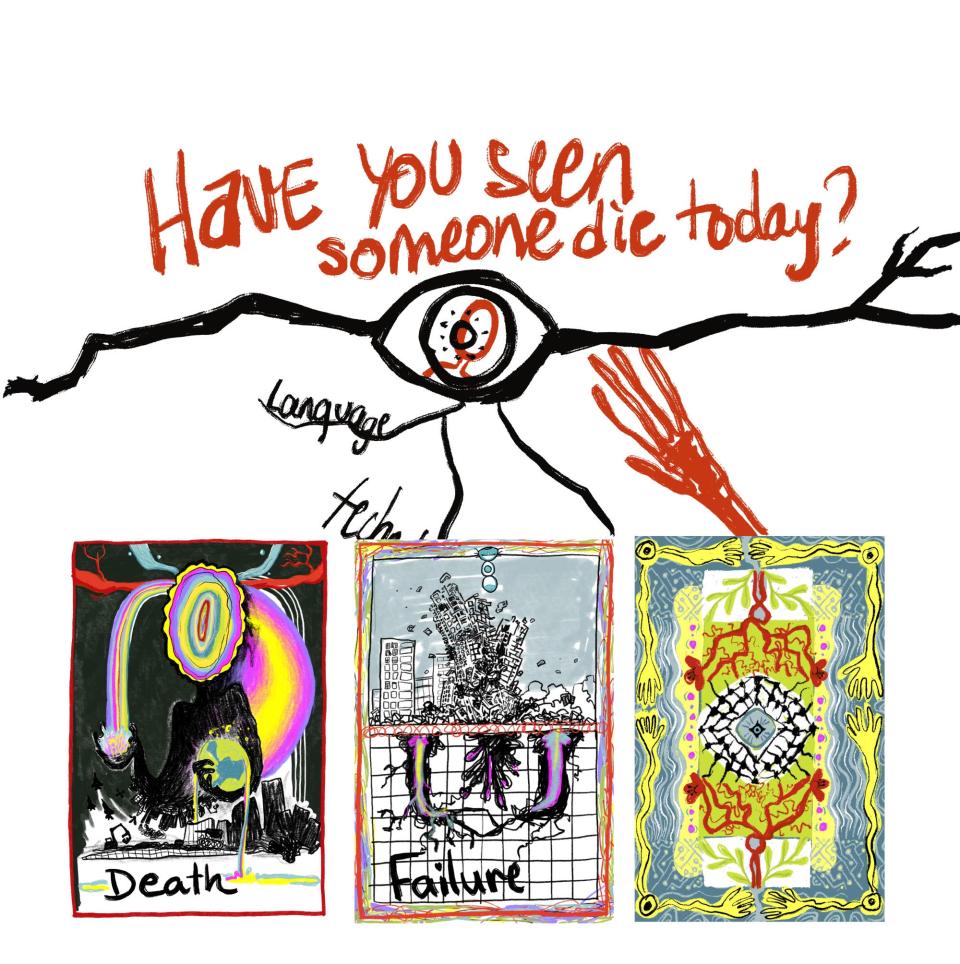
Illustration by Myra El Mir for FIRN
Summary of the project
Following the escalation of assault and genocide against the Palestinian people of Gaza and the West Bank after the 7 October 2023 operation, we at Kohl went on an open strike in mourning of our martyrs in Gaza, the West Bank and South Lebanon and as a call for action. This stemmed out of our belief in the necessity and urgency of a worker-led front when it comes to knowledge production. During this time, we halted our regular production, but continued to support and work with popular movements around the world around the ongoing Palestinian genocide. It was during that time as well that Kohl was heavily defunded by western donors. By the end 2024, we had lost two thirds of our funding, which only made sense in light of the regional context, the expansion of the genocidal war to Lebanon, and the complicity of imperial powers. After all, it has been proven time and time again that when it comes to anti-colonial work, the revolution will not be funded.[1]
It is at this juncture in time that we have come to conceptualise this research project with the Feminist Internet Research Network (FIRN) and Makan. The starting point of it was to explore the exploitation of western feminist narratives as tools for spreading misinformation, propaganda and rationalising war crimes and genocide, perpetuated through online platforms, while also highlighting the disparities between western feminists and intersectional feminists from the Global South. But as we turned our gaze away from enemy feminisms[2] and towards the Global South, we no longer wanted to converse with (or even against) imperialism and zionism. We detached ourselves from imperial feminism, which has historically let us down, and is now instrumentalising gender-based violence to justify and condone genocide. Instead, we came together, as Kohl, as Makan, as a hive of people who carry Palestine in our flesh, blood, hearts, or as an arch to the world – a political abode – to write about genocidal warfare, anti-colonial queer feminism, and what militancy means in the era of geopolitical borders and seemingly boundless technology.
Our research addresses genocide as a universal continuum of settler colonialism through its imbrications with technology and gender. We looked at genocide as a common occurrence for Indigenous and colonised peoples, despite what historical erasure tells us – faced with endless colonial expansion and capitalism, we have theorised this recurring reality and condition as “endless genocide”. We looked for ways to “unsilence” it through technology and finding each other across time and space. Yet, our relationship to the digital sphere is akin to our relationship with the world: fraught with gender-based violence because it is fraught with colonial violence, the brunt of which we bear with our bodies and existence in the world – physically as well as digitally.
Ultimately, in the era of AI-automated annihilation, we have had to sit with many new questions: the ways in which technology has brought about different proximities to genocide are complicated by the wound inflicted upon the land (occupation borders, hypersurveillance, hypermilitarisation, checkpoints…). We asked, over and over again, what sabotaging[3] the tools of colonial genocide and occupation, and embracing limitations as anti-colonial praxis, could look like. We struggled to name new forms of colonial separation we did not have the language for, and grappled with how different the practical application of militancy is today – the contours of which still don’t feel enough to address the magnitude of a livestreamed genocide.
In the era of AI-automated annihilation, we have had to sit with many new questions: the ways in which technology has brought about different proximities to genocide are complicated by the wound inflicted upon the land.
Method and theoretical framework
Our findings draw on a series of thought circles, co-organised by Kohl and Makan,[4] conducted remotely, and attended by about 15 anti-zionist scholars and activists, most of whom were queer Palestinians and Lebanese, dispersed across the world. We invited people with uneven proximities to violence, both theoretically and materially, but to whom Palestine is an ethical and political compass. We ran a series of workshops throughout 2024 and one final circle in June 2025. The conversations we held constitute the data that informed our analysis.
This collective, or hive, attended some or all of the workshops. During the final circle, we prioritised foraging work, which we understand as the gathering and sharing of personal and collective stories and experiences with coloniality from Palestine and across the globe. Makan cross-pollinated our foraged stories by rooting them in the tireless labour of educational and worker-led organising for Palestine, and helped us prune out the most obvious manifestations of colonial language and form in the research report. Our illustrator, Myra El Mir, gave us a jailbreaking card from linear form by turning our thought processes into visual concepts, in the final section “On Militancy: Reshuffling”. As for our weavers, they took on the task of weaving all of these components together, doing the labour of writing when writing became too unbearable for our hive, and putting the final touches where needed.
Theoretically, we tried to grow into a language that remains firmly intellectual but that does not reproduce western academic conventions. We succeeded in some ways and not in others. But throughout, we remained truthful to the feminist, queer and anti-colonial authors, activists, historical and contemporary figures, ordinary Palestinians and folx we read and love. We include them in the work organically, as companions to our conversations. We consider our conversations as part and parcel of organising, and like many intersectional feminists before us, we view all organising as praxis, and praxis as the doing of theory. Our conversations ultimately allowed us to theorise a militancy that repeatedly fails whilst recognising the transformative openings that vulnerability produces.
Reflection on the ethical process
In this piece, our collective, or hive, speaks from a Palestinian standpoint. It would be more accurate to say that we did our best to speak from an as-Palestinian standpoint as possible. A standpoint is a particular kind of knowledge that is shaped by and shapes one’s enmeshment with uneven systems of privilege and oppression.[5] Our hive’s experience and connection to Palestine is intimate, but not always geographical and material in the conventional sense. Our im/mobility, our relations, and the pre-1948 stories transmitted to us by our ancestors all point to the lifelong companion that Palestine is. At the same time, not all of us are refugees. Not all the refugees among us face equal im/mobility barriers. Some of us have read every book about Palestine in existence. Others were learning on the go, notably thanks to the foraging and pollinating work we did. Most did not endure decades of occupation and checkpoints. Our Palestinian standpoint, thus, is the total of many partial standpoints and is mostly told from a position of diaspora/exile. It echoes the standpoint of countless other colonised peoples across times and geographies, whose knowledge systems were governed by the enforced politics of diaspora and exile. This plethora of experiences forms a “strategic positionality” that responds to our immediate environment/audience in the face of accelerated genocide. From our locality, we establish Palestine as our anchor towards a global monumental struggle that transcends identity/ies – one that is anti-zionist, anti-capitalist, anti-colonial and abolitionist. We thus appreciate the partial situatedness from which this work is produced, and look towards further strategic positioning of Palestinanness.
From our locality, we establish Palestine as our anchor towards a global monumental struggle that transcends identity/ies – one that is anti-zionist, anti-capitalist, anti-colonial and abolitionist.
As for our positionality as weavers, we take no credit for the intellectual ideas we develop in this work. How we took on the role of weavers, and the labour that comes with it, was the result of the dynamics observed throughout the workshops, and which we described extensively in “What is method under annihilation?”[6] When annihilation debilitates us to the extent we can no longer attend to our jobs and mundane lives, reaching out and leaning into each other is what maximises the impact of the little time and energy we have left. Weavers weave, as accomplice work, but this research remains the result of a collective effort and a call to insist on collective authorship everywhere. We take this opportunity to remind ourselves that knowledge, particularly transformative and revolutionary knowledge, is always already collaborative. It relies not on the existing literature per se, as academic conventions would want us to believe, but on the lives and histories of innumerable communities whose survival remains subject to erasure.
Lastly, our unapologetic writing and deliberate choice to de-link from Global North definitions and modes of archiving meant that many among us, particularly those who do not benefit from the protective layer of an institutional cover, opted for anonymisation, or asked for their last name to be omitted. We include some of the intimidating tactics used by zionists and their sympathisers against us in our main piece, in addition to the obstacles we increasingly face inside and outside our workplace.
Research findings
-
Limitations and impasses
Our project repeatedly hit two main analytical conundrums. The first relates to language itself; the second to our forced alienation from Palestine. We choose to highlight them here because, by taking the form of cyclical conversation, they forced us to ask how to break the cycle and look for something entirely different.
Where language is concerned, we grew increasingly frustrated with the security-ridden ways in which the genocide is discussed in conventional media, political analysis, and NGO discourse. International law, national interest, statecraft and presentist paradigms were incessantly prioritised over the settler colonial origins of the Israeli state, aka the Nakba. It is this very same language that, for centuries, theorised the colonised as barbaric and belonging to the past, and portrayed the coloniser as a future-driven, civilised saviour. It is this very same language that rationalised, on social media and talk shows, the extent to which the mass murder and starvation of Palestinians is acceptable.
We understand language as a system of organisation that disciplines the thought before it disciplines the speech. Language is also genocidal forces playing sounds of crying children from drones, to lure Palestinians out of their homes – and kill them. By paying attention to language’s doings, we have struggled with and found ourselves short on words. We are bound by the monumental – and somewhat contradictory – task to write research that breaks the codes and limits of research, starting with its language. And yet, we are confronted with the fact that the very language of anti-colonial queer feminism amounted to a mere critique of white colonial feminism when faced with genocide. That no matter what we said and where we said it and how we said it, we could not stop the genocide. We therefore had to come up with something else entirely – and risk it being ineffective.
We understand language as a system of organisation that disciplines the thought before it disciplines the speech. Language is also genocidal forces playing sounds of crying children from drones, to lure Palestinians out of their homes – and kill them. By paying attention to language’s doings, we have struggled with and found ourselves short on words.
The second analytical conundrum we faced related to our alienation from Palestine. This alienation is multifaceted. In its simplest form, it refers to the diasporic condition of Palestinians since the Nakba in 1948 until today, which produces notable differences in relation to language (Arabic), geographical proximity, and the uses (or not) of armed resistance. At the theoretical level, the tools at our disposal were simply not capable of speaking to our localities. Not only is Palestine, and the region more broadly, reduced to case studies to be addressed from a western point of view; our diasporic condition means that we rely on colonial languages (mainly English, including anti-colonial scholarship). Most troubling still is the geographical alienation, through occupation borders and forced displacement, that we have to deal with when it comes to Palestine, and that makes traditional militancy and organising “on the ground” extremely limited in scope. At the ethical level, we spent hours reflecting on our locus of intervention, or the position from which we are speaking. Who speaks for Palestine? How can our uneven experience(s) with and relation(s) to Palestine coalesce into a monumental struggle for liberation? Lastly, the exigencies of modern life under late capitalism forcibly alienate us from Palestine because they force us to attend to paying jobs, against the urgency of organising to stop the genocide.
The sum of this three-fold alienation, combined with the limitations of language, led us to theorise the colonial separation of the shahed (witness) from the shaheed (martyr),[7] a specific kind of colonial mechanism brought about by the intersection of coloniality and technology. At the same time, our insistence on an affective language allowed us to theorise a militancy that most likely fails, and whereby failure is understood as an opening for renewed relationality and language.
-
The separation of shahed and shaheed
The main component of the colonial separation of shahed and shaheed is that it is brought about by technology itself and would not happen to the same extent without it. The colonial project partitions the land through isolating territories, checkpoints, forced displacement, cutting farmers’ access to the land… until total occupation and annihilation. Often, throughout history, colonisers ensured that these practices of erasure and mass killings were kept unknown, transmitted only through oral history within survivors’ communities. But through technology, we became outside observers to our own and our loved ones’ demise in Palestine. Outside of journalistic reels, thousands of Palestinians were live-streaming their anticipation of death. In Gaza, a shahed who tells the world of their own extermination is one missile, one bullet away from becoming shaheed – the genocidal colonial occupation targets and massacres journalists like Anas Al-Sharif and poets like Refaat Alareer.
For many of us who are exiled, watching live, in real time, the annihilation of your own people when you are physically prevented from entering the land – realising that no matter what you say or do, the genocide is still ongoing – is a continuation of the colonial aggression. The separation of shahed and shaheed abounds in western theory and literature, but for our communities, it has always symbolised a relational form of intimacy and resistance. Those who live this uprootedness find themselves insiders through affect, politics, ancestry, and family and community bonds, as well as outsiders, watching their loved ones carry the burden of the genocide with their bodies. Despite the physical distance, technology brings about a different, colonial perception of time: there is no time for the shahed to take a break from the news, no chance to be informed of the death of a loved one when seated, no time to take shelter from the realisation that one’s entire family no longer exists or to catch one’s breath and reflect on the passing of a loved one.
Throughout history, colonisers ensured that these practices of erasure and mass killings were kept unknown, transmitted only through oral history within survivors’ communities. But through technology, we became outside observers to our own and our loved ones’ demise in Palestine.
We thus expand on this uprootedness to convey an affective understanding of genocide, not to add to the existing debate on what constitutes genocide (we couldn’t care less about that), or expose the latter for its insidious workings (we already know that), but to insist on our refusal to be rendered dis-affected as simple observers. By archiving this colonial separation over an extended period, we refuse to let our feelings be treated as suspicious and unscholarly in the face of “big” world events. By doing so, we break away from academic conventions of research as we know them. Such is the magnitude of our collective failure to call out a genocide for what it is in spite of the vast scholarship that exist on it!
If heart is where the battle is, then archiving our diasporic and affective relations to the genocide is to fight for home. We archive the genocide in its minute details, not as witnesses but as shahed, for fear that its truth be taken from us. While the endless use of technology and AI is lauded as prowess, it is this same colonial use that is behind the automation of mass killings of those who are flagged as so-called “militants” and their families. To understand our limitations, including our use of technology, also meant to go against the expansionist logic of colonial AI.[8] After all, who knows which knowledge/s is/are being scraped from those specific, mass-scale data AI systems? We don’t know who’s using that knowledge, we don’t know where it’s being stored, and we don’t know what’s going to be done with the forms of knowledge that go against these imperialist timelines. Past images of genocide evoke the burning of books; what is the equivalent of book burning in this day and age?
-
Militancy
Militancy for the colonised was traditionally defined as actions that are taken “on the ground” with the aim of liberating the land. Therefore, those who have been forcibly displaced from their homeland, and who bear this colonial separation, find themselves outside of that definition. But a decolonial use of technology, and of the knowledges that have been transmitted to us by non-hegemonic means, expands on that definition. Militancy, in this day and age, is the accumulation of visible actions undertaken globally, and facilitated by the use of technology (whether happening online or as a result of the transmission of information online). And most importantly, as have all actions been in stopping the genocide, it is mostly ineffective. The kind of militancy we embrace is one that repeatedly fails. Failure, however, is not an end. It is a call to action. Failure is also the locus from which new openings can happen. We invite our readers to resist turning inwards, and to turn towards other agitators.
Militancy is not a single definition, but an assemblage of affects, tools and doings that come together to commit in life as in death – a way of life. An assemblage may appear cohesive on the surface, but what truly holds it together is an often messy and invisible labour that works around the clock to sustain it.
While the endless use of technology and AI is lauded as prowess, it is this same colonial use that is behind the automation of mass killings of those who are flagged as so-called “militants” and their families.
In our attempt to circumvent the dominant language used to deal with genocides, be it the very field of humanitarian law or anti-colonial writing itself, we opted for poetics-politics as the form, or language, to articulate militancy. Poetics are a vehicle through which we preserve our ability to become political narrators; through them, we speak and act as counter-discourse and counter-aesthetics to academic conventions.
We push Black feminist Walidah Imarisha’s notion that “all organizing is science-fiction”[9] to the limit and draw on the absurdity of our historical moment, which fails to name an unending genocide rejected by millions whose states do not speak for them. We attempted to imagine differently from the colonisers, by developing a set of cards mimicking a tarot reading to provoke our audience into thinking otherworldly. Card readings are other forms of marginalised knowledge that have resonated with politicised queer communities around the world. Additionally, it allows us to visually represent the mess that is militancy at this moment in time: our deck of cards combines illustrations that ask (what we hope are) disruptive questions, in order to poke holes at the colonial language we have been stuck with. The five suits we identified (affects, states, tools, builders, tomorrows) are nowhere near comprehensive to militancy as a whole, but they have arisen as the most pressing thoughts of our hive during the process of bringing this work to completion. The cards are meant to work as a tool guide, as well as a mind map: you can sit with the questions and the deck, with friends and accomplices, or select your personal questions of the moment, and these will direct you to one or more cards. No matter what, the deck always allows you to add and draw your own conclusions – and develop them in tandem with a community, wherever you may be in the world.
Conclusion and recommendation
In this work, we recommend breaking away from the language, including the form of intellectual work that we have been accustomed to. We look for new platforms to make our work known, outside of academic bubbles. We work collaboratively precisely for the purpose of confusing our line managers and dodging institutional research metrics. We speculate on non-REF[10] modes of knowledge delivery such as poetry, storytelling, essays lacking literature reviews, tool guides, and yes, illustrated tarot cards. These tools are not random. They are the tools that constitute the very foundations of our cosmology: what matters to us and how we come to archive what matters to us. Tarot cards encapsulate the unknown, the yet-to-be, the could-haves and the would-haves. These “gaps” are precisely what inform our trans-Indigeneity: the last of our terrains for a common language that is yet to be fully co-opted by colonial paradigms. After all, it was precisely the will to know Us and Others which enabled colonisers to rank some bodies above others, to discard all cosmologies that insist on the otherworldly (read non-modern/western/colonial), and to remain steadfast in their attachment to partial and relational knowledge.
The good old saying that decolonising starts with one’s self rang true for us. We learned from each other throughout the project about further genocides and settler colonialisms taking place elsewhere in the world, beyond Palestine. Such a reality hinders transnational Indigenous work because it equivocally prioritises one genocide above others, which reiterates colonialists’ mode of manufacturing narratives. Where technology is concerned, for instance, we learned that the world’s most comprehensive biometric system for “managing” refugees is being deployed in the Za’atari camp in Jordan (Syria’s forcibly displaced). We recommend, therefore, to chip away at colonial geographies, and turn towards the Global South. The idea is to not only show “reciprocal solidarity” to other peoples who are dealing with genocide as well, as solidarity can be performative, but also learn about their history as they learn about ours, and talk across borders. Only then we might have a chance to organise, in order to break through the endlessness of genocide – and stretching ourselves towards the timelessness of our common struggle. After all, one of our main recommendations for any project that centres transnational anti-colonial solidarity, is to reckon with its own assumptions and provincialisation pitfalls.
Our final recommendation relates to the untapped possibilities of weaving differently across movement/time. Our collective barely scratched the surface of anti-genocidal organising. Whereas the refusal we relate in our project is mostly textual and affective, the expected result of the intense paralysis and dissociated selves we experienced (and continue to), supply chains and logistics still rely on manual labour for shipping and delivering not only weaponries, but all sorts of commodities under a handful of corporate brands servicing (read financing) zionism. We are alert to the immediate results that weaving differently across movement/time is capable of producing, notably worker-led, union and cross-movement organising.
Footnotes
[1] INCITE! Women of Color Against Violence (2017). The Revolution Will Not Be Funded: Beyond the Non-Profit Industrial Complex. Duke University Press.
[2] Lewis, S. (2025). Enemy Feminisms: TERFs, Policewomen, and Girlbosses Against Liberation. Haymarket Books.
[3] Gayatri Spivak talks of “affirmative sabotage” of the Master’s tools. See: Spivak, G. C. (2012). An Aesthetic Education in the Era of Globalization. Harvard University Press.
[4] Set up and led by members of the Palestinian diaspora, Makan provides transformative education aimed at strengthening the movement for Palestinian liberation, contextualising Palestine within the broader framework of social justice and global liberation movements. https://www.makan.org.uk/
[5] Collins, P. H. (2000). Black Feminist Thought: Knowledge, Consciousness, and the Politics of Empowerment. Routledge.
[6] Allouche, S., & Sayegh, G. (2025, 28 April). What is method under annihilation? Notes on queerness, death and data. GenderIT.org. https://genderit.org/feminist-talk/what-method-under-annihilation-notes-queerness-death-and-data
[7] Lina Mounzer notes that in Arabic, the root of the verb “to witness” (sh-h-d) gets us “shahed, the one who witnesses; mashhad, the spectacle or the scene, but also shaheed, martyr; istishhad, to be martyred, to die for a cause.” See: Mounzer, L. (2016, 6 October). War in Translation: Giving Voice to the Women of Syria. Literary Hub. https://lithub.com/war-in-translation-giving-voice-to-the-women-of-syria/
[8] Della Ratta, D. (2024, 14 August). What does decolonising AI really mean? An interview with artist Ameera Kawash. UntoldMag. https://untoldmag.org/what-does-decolonising-ai-really-mean-an-interview-with-artist-ameera-kawash/
[9] Imarisha, W. (2015, 11 February). Rewriting the Future: Using Science Fiction to Re-Envision Justice. https://www.walidah.com/blog/2015/2/11/rewriting-the-future-using-science-fiction-to-re-envision-justice
[10] The REF is the UK's official system for assessing research quality in higher education institutions.
- 235 views


Add new comment