
Photo by Karl Solano on Unsplash
Smoke's rising from burning wires and smashed screens on the edge of Accra, near the Korle Lagoon in Ghana. This is Agbogbloshie, one of those infamous e-waste dumps in the world. Broken electronics from Europe and North America just end up there – keyboards, monitors, TVs, phones – all stripped by hand for whatever parts are salvageable. What’s left is dumped in the waters, often termed as one of the most polluted water bodies globally. The air is thick with melted plastic and heavy metals in the area which is basically the final stop in a global tech economy that runs on extraction and throwing things away.
But there's something else happening too. Feminist repair spaces are quietly growing, and are pushing back against all the extraction and scraping.
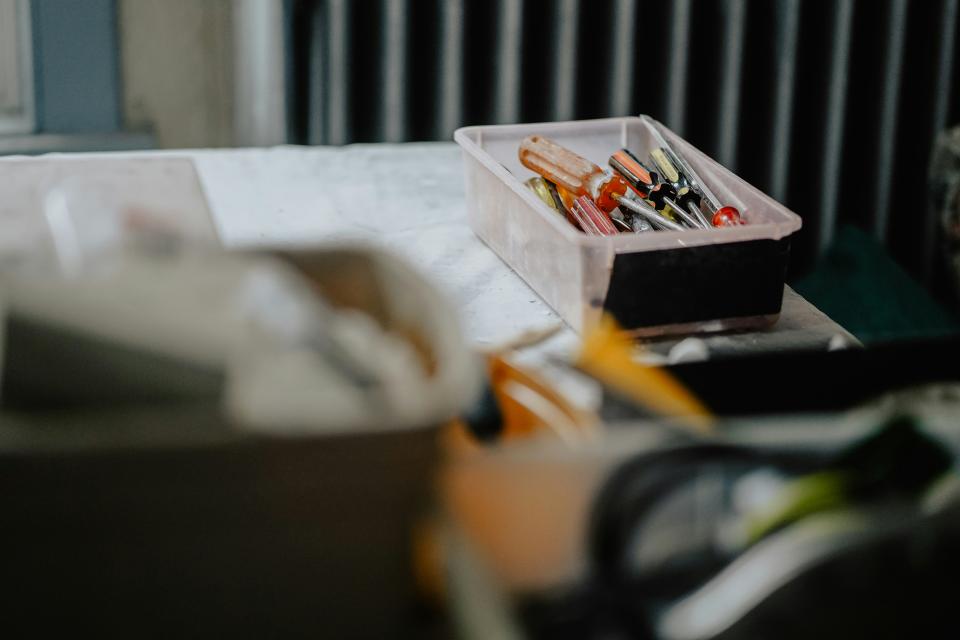
A few miles from Agbogbloshie, in a regular community hall in Accra, every Saturday afternoon, women and queer makers sit loose around broken radios, solar lamps, routers, and phones, with their tools spread out on cloth to teach and learn how to clean a corroded charging port, or running a battery testing, or repairing a broken screen.
Adjoa Owusu, one of the people running this community space, says, "We're not trying to build the next big app. We're trying to keep our tools alive long enough for people to survive."
That's what feminist repair labs are – community spaces where people gather to learn how to fix everyday tech together. Across Latin America, West Africa, South Asia, similar groups are tackling climate breakdown not through flashy innovation but through care, maintenance, and real autonomy. In places where floods, heat, and sketchy electricity kill devices faster than folks can replace them, repairs become a way to actually adapt to climate change which doesn't just mess with landscapes, it tears through infrastructure.
That's what feminist repair labs are – community spaces where people gather to learn how to fix everyday tech together.
The World Bank says that nearly 600 million people in sub-Saharan Africa don't have steady electricity, and even those who do deal with constant blackouts. Whereas, in West Africa, heat kills battery life faster, humidity eats away at circuits, power surges fry routers and chargers, floods soak radios, phones, solar gear. That kind of unreliability means things break early and constantly.
"When something breaks here, it hits hard," Adjoa says. "You might not afford another one. You might not be able to charge it. You might not even know what went wrong."
Communication devices are people’s only way to get weather warnings, receive money from family working elsewhere, run their small businesses, stay connected, organise help, and live their everyday life as normally as possible. When those devices die, people become more vulnerable.
Repair labs fill that hole. Most tech culture obsesses over disruption, speed, and new and latest shiny stuff. Feminist repair labs go the other way – slow, built on relationships, tied to what people actually need – usually run by women and queer organisers who deliberately work against the idea that only certain people get to be "technical."
In Accra, informal feminist tech networks connected to coding clubs, community radio, and women's groups have built spaces where a lot of people are trying this model for the first time, and picking up hardware skills traditionally gatekept by men. Some of the skills include soldering, inspecting what's broken, and circuitry among others.
Across the Global Majority, feminist repair labs often operate with limited resources. Many are self-funded by organisers or run on small grants from local NGOs, community foundations, or solidarity networks. Adjoa notes, “We get by on what people can donate and what we can scrape together ourselves. There’s no big tech backing us — that’s part of why we do it.”
Adjoa further adds, "We start by saying: this isn't magic, it's something you can learn."
Instead of diagrams, these labs start their workshops with talking. Who's using this thing? Who needs it to work? What goes wrong if it stops? A radio that broadcasts flood warnings gets treated urgently. A solar lamp running a night market stall gets treated with real attention. Here, fixing something isn't about proving you're smarter or having control. It's about responsibility and community care.
Most tech culture obsesses over disruption, speed, and new and latest shiny stuff. Feminist repair labs go the other way – slow, built on relationships, tied to what people actually need – usually run by women and queer organisers who deliberately work against the idea that only certain people get to be "technical."
Adjoa shares, "If you depend on something, you should understand how it works."
That's the total opposite of how the Big Tech industry operates. Devices get built from minerals pulled from the Global Majority, made under awful conditions, then dumped back in the same regions as toxic garbage. Ghana gets hit with around 150,000 tonnes of e-waste yearly, a lot of it shipped there illegally. Agbogbloshie became known specifically because it made that destruction visible.
Feminist repair labs work by fixing the devices before they hit the waste pile. These spaces believe that every charger that lasts another year means one less thing that needs mining, making, shipping, trashing.
Similar things are happening across the continents in Latin America. For instance, in Oaxaca, Mexico, feminist tech groups run digital autonomy workshops where people don't just learn how to use devices, they learn to actually maintain them and push back against the whole built-in obsolescence thing. Similarly in Bengaluru, India, queer-led collectives do neighbourhood "Fix It" days where folks bring broken fans, tablets, radios, speakers, whatever needs work.
Ananya says, "The industry wants us to forget how to fix things. Because if we forget, we're trapped being dependent." Repair becomes their act of refusing to throw stuff away. And when faced with a crisis, this refusal turns into a survival effort.
In Bengaluru, India, and Bogotá, Colombia, feminist labs rely on volunteer labour, donated equipment, or partnerships with coding clubs and local universities. Despite the funding-related constraints, organisers say sustainability comes from the community itself: participants learn, teach others, and gradually build a small but resilient ecosystem. “We don’t need a fancy budget,” Ananya explains, “We need hands and curiosity. That’s what keeps people coming back.” Funding may be scarce, but the commitment of people who depend on these spaces for skills, support, and survival ensures they persist – a model of resilience rooted in care rather than capital.
During the 2024 floods in southern Brazil, grassroots tech networks stepped in to get communication tools working again for mutual aid groups when the official systems basically collapsed. Community organisers ended up relying on repaired radios and routers to coordinate where food was going and how people could evacuate safely.
In coastal Bangladesh, women-led solar repair collectives work to keep charging stations and lanterns running after cyclones hit. When the power is out for days on end, these devices keep phones charged, which means families can reach relief networks and get weather updates that might save their lives.
What sets feminist repair labs apart isn't just what they're fixing, it's how knowledge actually flows through them. It's not locked up behind certifications or institutions, and gets passed directly from one person to another in a community setting where the skills are shared.
Similarly, Northern Ghana's community radio stations depend on repaired transmitters to broadcast flood warnings when the rainy season comes around.
A technician working with a women-run station near Tamale, Ghana, says, "When the radio goes down, people are in the dark about what's coming. Fixing it is literally fixing safety."
In those moments, repair stops being about symbolism, and becomes actual infrastructure.
What sets feminist repair labs apart isn't just what they're fixing, it's how knowledge actually flows through them. It's not locked up behind certifications or institutions, and gets passed directly from one person to another in a community setting where the skills are shared.
In Lima, Peru, older women teach younger people how to really listen to machines, how to hear when a motor is struggling, how to smell when plastic is starting to overheat. In Accra, teenagers show elders how to reset routers and update firmware. It is a shared knowledge with an understanding that nobody is the expert at everything, and everyone is picking up something new to increase community skills.
Maria, a facilitator at a feminist hackerspace in Bogotá, explains, "We don't separate thinking from doing. Your body learns too."
This kind of knowledge is slow, and is dependent on the relationship of trust while rejecting the whole notion that technology is only for people with formal authority.
Mainstream climate talk usually pushes big solutions: AI models, smart cities, carbon capture tech. Feminist repair labs offer something different, quieter, usually more grounded in reality and collective care for the community and for the environment. They're not promising to fix the whole planet, rather what's right in front of them;
A router.
A radio.
A charger.
A solar lamp.
Instead of asking how to innovate faster, they ask how to take care of what we already have. That's climate adaptation built from the ground level up.
Back in Accra, there's a woman named Efua sitting at the repair table with a solar lantern that stopped working after a storm. She opens it up carefully, cleans the contacts, replaces a wire that came loose. The light turns back on.
She laughs, not because it's perfect, but because it works again.
Feminist repair labs don't hand you utopia, instead they give you continuity. In a world that's built on taking everything and burning it out, they stand for caring instead of consuming, building skill instead of dependency, and community instead of isolation.
Repair is radical, and it says that we’re not throwing each other away; we're not throwing our tools away; and we're staying put, and we're fixing what we can.
In a time when the world’s climate is falling apart, the right to repair might actually be one of the most powerful ways we know how to resist.
- 52 views





Add new comment