


In an essay in 1986, the acclaimed science fiction author Ursula K. Le Guin critiqued fictional works that disproportionately emphasise the archetype of the hero, his acts of bravery, violence and weapons of power.[1]
To elaborate on her critique, Le Guin draws upon the Carrier Bag Theory, proposed by Elizabeth Fisher in her book Woman’s Creation.[2] This theory argues that the narrative of human evolution is incomplete when it focuses solely on hunting and the invention of tools such as spears, axes and arrows. According with this theory, activities like gathering and storing food – traditionally believed to be performed solely by women – were equally vital to humanity’s survival and development. These practices were a crucial step in enabling humans to adopt a nomadic lifestyle and explore new territories. Le Guin, drawing on Fisher's ideas, suggests that before "sticks and spears and swords, the things to bash and poke and hit with, the long, hard things [...] the first cultural device was probably a recipient".[3] This leads to the metaphor of the carrier bag, which illustrates that “with or before the tool that forces energy outward, we made the tool that brings energy home”.[4]
The hero’s tale, though limited, is filled with action and power, exalting narratives of victory and conquest. And because such stories are perceived as more “exciting” and “attractive”, they continue to dominate most science fiction productions to this day, whether in literature or audiovisual media.
Le Guin’s argument emphasises that by focusing exclusively on the hero, countless other stories risk being left untold.
The Carrier Bag Theory, whether applied to human evolution, science fiction or extended to feminist science and technology studies, introduces a new type of storytelling, one that challenges the logics of invisibility and silencing.
Perhaps the reader who has progressed to this point is wondering why the opening paragraphs of an article exploring ethical issues in feminist research delve into a theory of fiction. To begin with, it must be acknowledged that the authors of this article are passionate admirers of Ursula K. Le Guin and her extensive work. However, this is not the (only) reason for Le Guin’s significant presence in this text. The Carrier Bag Theory, whether applied to human evolution, science fiction or extended to feminist science and technology studies, introduces a new type of storytelling, one that challenges the logics of invisibility and silencing. Moreover, it disrupts our socio-technical imaginary of science and technology, or the so-called “common sciences”.[5]
If science fiction is the mythology of modern technology, then its myth is tragic. ‘Technology,’ or ‘modern science’ ... is a heroic undertaking, Herculean, Promethean, conceived as triumph, hence ultimately as tragedy. ...
If, however, one avoids the linear, progressive, Time’s-(killing)-arrow mode of the Techno-Heroic, and redefines technology and science as primarily cultural carrier bag rather than weapon of domination, one pleasant side effect is that science fiction can be seen as a far less rigid, narrow field, not necessarily Promethean or apocalyptic at all, and in fact less a mythological genre than a realistic one.[6]
Here we arrive at the core of our argument: redefining technology and science not as weapons of domination, but as cultural carrier bags.
Throughout our research, we encountered the challenge of moving beyond traditional dichotomies – such as subject and object – and conventional notions of scientific rigour when working to establish more horizontal and collaborative research relationships.[7]
The main question guiding our research was: could digital forensics help tackle technology-facilitated gender-based violence? For the development of this study, we collaborated with other groups in Latin America who want to explore the potential of digital forensics in the context of human rights defense. We dialogued with international human rights and technology organisations that respond to digital threats to civil society and are well recognised as references in the field of digital forensics and advanced threat analysis. We also worked with Feminist Helplines from Latin America, with whom MariaLab had undertaken previous joint projects and therefore had an existing relationship of trust.[8]
We recognise that our personal experiences and political engagement with the topic are integral to the research process, and that critical self-reflection on our positions is essential to the production of knowledge.
It is important to note that in this research, we occupy dual roles as both researchers and participants, being directly invested in the subject under investigation. This duality of “investigating” and “participating” is inherent to our practice as a feminist hacker organisation. However, when applied within a scientific research context, it requires additional care and thoughtful reflection. We recognise that our personal experiences and political engagement with the topic are integral to the research process, and that critical self-reflection on our positions is essential to the production of knowledge. This also involves acknowledging the power and privilege that come with “community trust”, often rooted in shared identities.[9]
The feminist critique of modern science represents one of the most fertile grounds for the development of a research ethic that challenges and refutes notions of scientific objectivity, asserting instead that all science is socially and historically constructed. Scholars in the field of science and technology studies, such as Evelyn Fox Keller[10], Sandra Harding[11] and Donna Haraway[12], argue that all knowledge is situated – meaning it emerges from a specific context of creation and is shaped by underlying assumptions that must be explicitly integrated into the analysis itself. Situated knowledge, localised knowledge or partial perspectives form the core of this epistemological framework, emphasising the situatedness and partiality of knowledge. According to this approach, every theory originates from particular motivations, experiences, connections and reflections.
Recognising this bias, we sought methods to ensure that the ideas, data and experiences gathered in our research were not merely reflections of the individuals documenting them. Action research – a process of investigation that intentionally seeks to generate practical effects within the reality being studied – was the path we chose to adopt.[13] This method dialogues closely with our interpretation of technology as knowledge organised around action.[14]
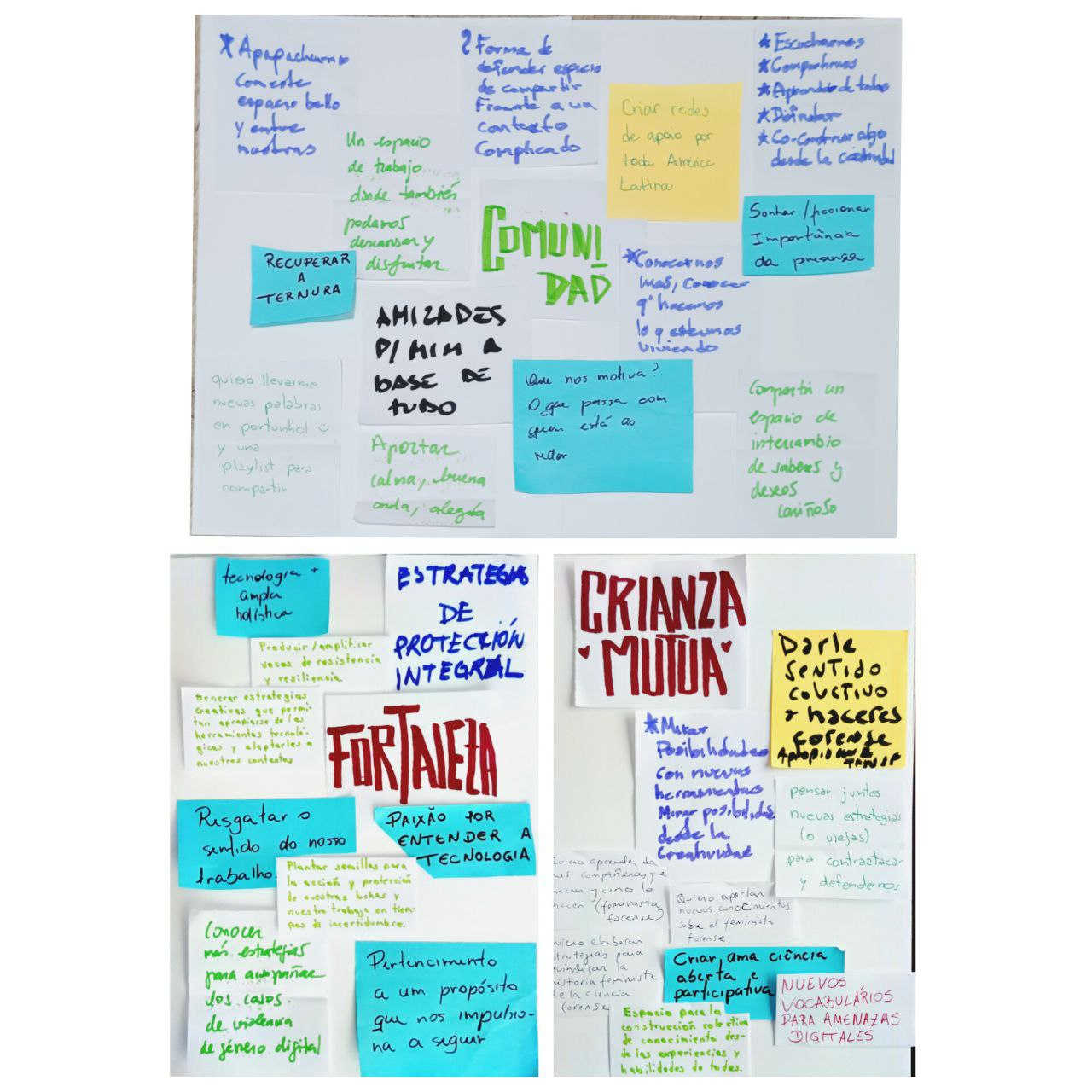
As part of our research methodology, we organised an in-person meeting with at least one member of each of the feminist digital helplines participating in this project.[15] We brought an actual bag to this meeting and invited each participant to place an item inside that they considered a significant contribution or take away from this research process. This icebreaker activity served as a playful way to begin the presentations, but it also laid the groundwork for an open and collaborative process of knowledge creation. Through this dialogue, we narrowed down our ideas into three main points, which became the pillars of our research process.
Comunidad. Fortaleza. Crianza mutua.
Comunidad.
The sense of community we have cultivated with the individuals and groups involved in this research predates this investigation and will endure long after its conclusion. Among the ideas placed in the bag, we encountered words such as desire, dream, tenderness and friendship, alongside requests to share words in “Portuñol” and playlists of Latin music – elements that would rarely find a place in the narratives of heroes or the theoretical treatises of traditional scientific paradigms.
Since our beginnings as members of the digital security community, guided even then by the feminist perspective we embrace here, we have always operated on the basis of a “safe space”. This concept refers to an environment that fosters the development of ideas and the exchange of experiences, where the well-being of all participants is prioritised. For this reason, building friendships, sharing nourishing meals and respecting moments of rest are fundamental elements of our approach.
Fortaleza.
Recognising the knowledge generated through practical action and everyday work is a principle we consistently reaffirm. Understanding and asserting that the academia is not the only place for constructing knowledge allows us to remain vigilant about the power hierarchies that can permeate research – even within our own “safe spaces”. By integrating diverse forms of learning and practice, we expand the possibilities for empirical analysis while simultaneously strengthening collaborative efforts.
Understanding and asserting that the academia is not the only place for constructing knowledge allows us to remain vigilant about the power hierarchies that can permeate research – even within our own “safe spaces”.
One common characteristic among the participants in this meeting is their view of digital care as integral to a process of empowerment and capacity-building. This stands in contrast to the militarised logic of the “information security” field, which emphasises “attackers” and “exploits”, reducing protection to the narrow practice of “preventive security”. For the group present, protection and empowerment are intertwined, forming part of a broader process of growth and transformation, one that centres people and the principle of “do no harm”.
The group itself comprises an intersection of diverse individuals, each bringing their own experiences, activisms, cultures and passions. When these elements intertwine, they create a rich tapestry of knowledge that calls for transformative technologies and for actions to be expansive in their reach, rather than narrowly ultra-specialised.
Bringing these reflections to both the beginning and the end of a meeting focused on sharing ultra-specialised practices is intentional and deeply symbolic. Thus, when we conclude our meeting with a forró (Brazilian dance) workshop, it served not only as an enjoyable activity that connects us to our bodies and to one another, but also as a way of celebrating and experiencing a rhythm recognised as part of Brazil’s intangible cultural heritage.[16]
Crianza Mutua.
This expression means more than just the process of creating together, and emphasises the importance of continually nurturing and sustaining this collective creation.
We have committed ourselves to developing alternative vocabularies that reflect the specificity of experiences, challenging hegemonic categories and concepts.[17] Rather than merely reproducing dominant frameworks, we strive to construct forms of expression that enable new narratives to emerge.
The creation of this community is inherently collective – not just in principle, but in practice, built through numerous “safe spaces” and shaped by many hands. In perspective of a free and open production process, ideas circulate, inspire, are reimagined and remixed and continue to flow, feeding back into and enriching the ongoing cycle of creation.
The creation of this community is inherently collective – not just in principle, but in practice, built through numerous “safe spaces” and shaped by many hands.
This also prompted us to reflect on the concept of authorship. Who are the authors of this text, and of future works arising from this project? How can we credit the originality of the ideas we have gathered beyond the classic form of quoting authors and interviewees? Are references alone sufficient, or do they perpetuate a divide between researcher and participant?
And how do we deal with the fine line between anonymity-security and recognition-visibility when we are dealing with complex subjects, especially when addressing issues such as combating violence and the intersecting inequalities of gender, race, class and sexuality? To what extent does naming the individuals who contributed to this research expose them to potential risks?
The concepts of risk and security are deeply familiar to us through our work. As feminist helplines, we engage daily in acts of resistance and incident response; anonymity and risk analysis are central tools to our practice.
Yet, despite our experiences, these questions continue to resonate with us, and we still do not have definitive answers.
For now, we have chosen to name all contributors. From a traditional digital security perspective, this decision may seem illogical, perhaps even incoherent, risky or selfish.
Our bag is shared and carried by the hands of Mariel from Luchadoras; Daniela from Técnicas Rudas; Nara and Nina from Centro S.O.S. Digital; Su and Pris from Navegando Libres por la Red; Sophie from Université Laval (Canada); Lino from Rede Transfeminista de Cuidados Digitais; and Tes, Ashi, Chan, Paty, Dany and Carl from MariaLab.
The act of naming everyone is not tied to a heroic act of defence or attack but rather an effort to “bring the energy home”. It is about reaffirming and preserving the how, the who and the why alongside the what. To motivate, to dream, to share – these are our guiding principles. Building something is important, but understanding who builds, how they build, why they build and for whom is what truly drives us.
Footnotes
[1] Le Guin, U. K. (1986). The Carrier Bag Theory of Fiction. https://theanarchistlibrary.org/mirror/u/uk/ursula-k-le-guin-the-carrie…
[2] Fisher, H. E. (1980). Woman's Creation: Sexual Evolution and the Struggle for Female Power. McGraw-Hill Book Co.
[3] Le Guin, U. K. (1986). Op. cit. 2.
[4] Ibid.
[5] Chibeni, S. S. (2004). O que é ciência? Instituto de Filosofia e Ciências Humanas da Unicamp, 1-17. https://unicamp.br/~chibeni/textosdidaticos/ciencia.pdf
[6] Le Guin, U. K. (1986). Op. cit. 4.
[7] The research project "Feminist digital forensics: A study and a proposal for development" is being developed by MariaLab, a Brazilian feminist non-profit organisation working at the intersection of gender, technology and politics. The project is part of the Feminist Internet Research Network, a collaborative and multidisciplinary research project led by the Association for Progressive Communications and funded by the International Development Research Centre.
[9] Hussen, T. S. (2019, 29 August). "All that you walk on to get there": How to centre feminist ways of knowing. Feminist Internet Research Network. https://firn.genderit.org/blog/all-you-walk-get-there-how-centre-feminist-ways-knowing
[10] Keller, E. F.. (2006). Qual foi o impacto do feminismo na ciência?. Cadernos Pagu, (27), 13–34. https://doi.org/10.1590/S0104-83332006000200003
[11] Harding, S. (1987). Introduction: Is there a Feminist Method? In Feminism and Methodology: Social Science Issues. Indiana University Press
[12] Haraway, D. (2009). Saberes localizados: a questão da ciência para o feminismo e o privilégio da perspectiva parcial. Cadernos Pagu, (5), 7–41. Recuperado de https://periodicos.sbu.unicamp.br/ojs/index.php/cadpagu/article/view/17…
[13] Tripp, D.. (2005). Pesquisa-ação: uma introdução metodológica. Educação E Pesquisa, 31(3), 443–466. https://doi.org/10.1590/S1517-97022005000300009
[15] The feminist digital security helplines participating in this project are Maria D’ajuda, Navegando Libres, Tecnicas Rudas, Luchadoras and Centro S.O.S. Digital.
[16] Tolentino, I. (2019, 24 October). Forró and the relationship between music, dance and identity. Corpuslab. https://corpuslab.info/forro-e-as-relacoes-entre-musica-danca-e-identidade/?lang=en
[17] Oliveira, D. P. de ., Araújo, D. C. de ., & Kanashiro, M. M.. (2020). Tecnologias, infraestruturas e redes feministas: potências no processo de ruptura com o legado colonial e androcêntrico*. Cadernos Pagu, (59), e205903. https://doi.org/10.1590/18094449202000590003
- 306 views




Add new comment