

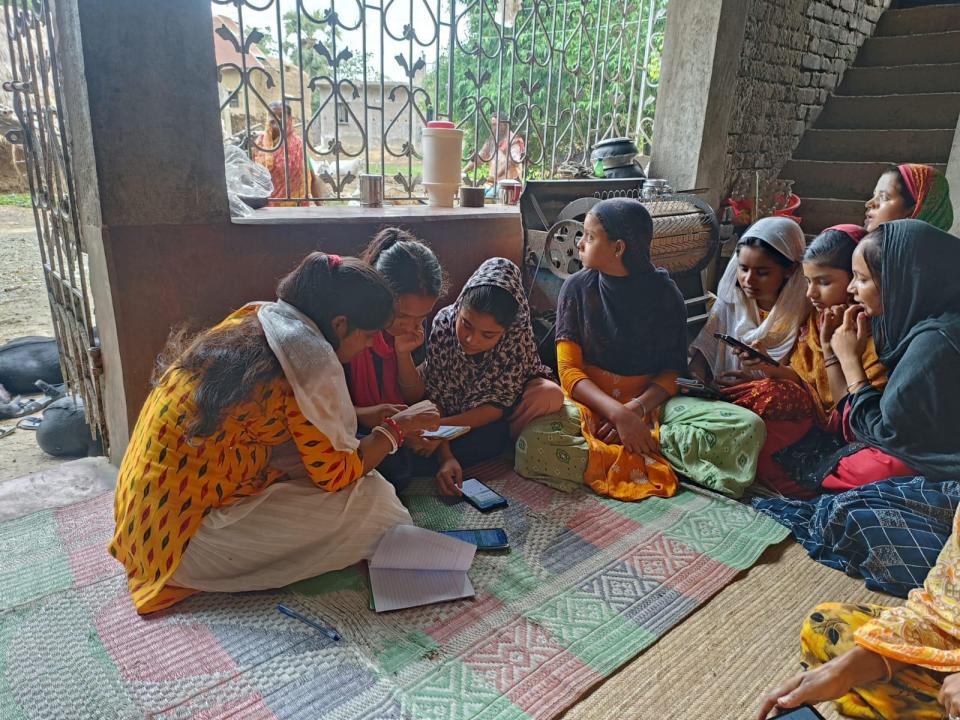
Women in Chhattisgarh learning fact-checking - Image: Poorvi Gupta
When Premlata Verma’s Instagram account was hacked, the hacker used her account to post sexualised images and videos of women. The 26-year-old Premalata from Vishrampur village of Chhattisgarh, says, “I was deeply scared.” She adds, “I feared that my family would be very upset and they would kill me.”
When Premlata got her first smartphone in 2017 through a government scheme – Chhattisgarh Sanchar Kranti Yojana (Chhattisgarh Communication Revolution Scheme) aimed to empower women in rural households with digital access, she dived into the world of social media very quickly. She made a public Instagram account in 2023 that gained thousands of followers.
“I posted some photos of me and my family on it. But soon after, I forgot about it and didn’t see it for many days. After a few months, my friend called me and asked me why I was posting obscene images of girls on my Instagram account and I was shocked,” she shares.
India is home to approximately 806 million internet users in 2025, as per DataReportal. A 2025 survey conducted by Ipsos Group – a Paris-based market research firm, concluded that Indians have the weakest ability to distinguish between real and fake information in comparison to the UK, France and the US. As a result, rural internet users, particularly women, are disproportionately impacted by misinformation and cybersecurity threats in the absence of robust fact-checking mechanisms and digital literacy in regional languages.
Premlata says that as a result of the hack, her friends, who had seen her Instagram account, distanced themselves from her. “I felt ostracised… I would hear people say that she must have done it herself, that’s why she roams around so much.”
Fortunately for Premlata, she was able to seek assistance through the Digital Empowerment Foundation (DEF) – a Delhi-based NGO which runs a Critical Digital Literacy Module Training in some parts of Chhattisgarh.
“It had only been some time since I had joined the training from DEF when my account was hacked. I instantly called the program coordinator Kaushal, who called a meeting the next day with several women and not only helped me delete my Instagram account but also made us aware of the many cybersecurity issues that could happen on social media,” recalls Premlata.

Hacking is one of the many ways cybersecurity is under threat, specifically in rural areas in the country. In Chhattisgarh, we spoke to several women from rural districts who shared that financial frauds, gendered myths around health and hygiene, misinformation around government schemes, and false narratives targeting women’s social media use are rampant online in the state.
Kalyani Tandon from Mohdi village who has also been part of DEF’s training sessions, shares that at least four women in her village fell victim to a fake job advertisement on Facebook, which lured them into sending money to the scammer who promised a full-time job in pencil box packaging for a fake company. “A girl came to me to transfer the amount, so I ignored it the first two times she sent Rs. 6000 (US$69.5), but then she asked me to loan her the amount to send it to someone. That’s when I asked her and she, very reluctantly, told me that she will get a job once she makes the transfer. I felt something fishy, so I inquired further and that’s when I got to know that she had been scammed, as the person on the other end had shared doctored identification proof and a fake name. She couldn’t recover her money, but at least she stopped it immediately,” shares Kalyani, adding that girls in the village don’t tell that they got an online opportunity to work because of the existing lack of employment opportunities.
Women also shared how misinformation around the COVID-19 vaccine made rounds on WhatsApp prompting reluctance amongst village folks to get vaccinated. Kalyani says, “Generally, gendered health-related misinformation and fake news on menstruation keep popping up in the village that travels widely through social media, but since I’ve joined DEF and we were trained in digital literacy and fact-checking, I actively work towards debunking such misinformation.”
Generally, gendered health-related misinformation and fake news on menstruation keep popping up in the village that travels widely through social media.
- Kalyani Tandon
Bridging the gap of critical digital literacy
Before joining DEF, Kalyani worked as a grassroots financial agent under the State Rural Livelihood Mission (SRLM) – a government initiative to promote rural livelihood. As a financial agent, Kalyani helped the village community with pension disbursement queries, opening women’s Self-Help Group bank accounts, and providing doorstep digital banking services using biometric devices.
“When I became [the financial agent], that’s when my husband bought me a smartphone as it was a requirement for the work. But I didn’t have a complete understanding of using it effectively,” says Kalyani.
Chhattisgarh’s mobile connectivity increased in the last few years owing to the government scheme of distributing mobile phones to rural households, and especially to women, reducing the gender divide in mobile usage. However, a 2022 report by the Internet Freedom Foundation highlights that rural areas face a disproportionate impact from misinformation due to the low levels of digital literacy, which is particularly severe on rural women due to socio-cultural constraints.
To counter the issue of lack of information and to increase digital literacy among women in rural areas, DEF launched the Soochnapreneur (Infopreneurs) initiative to address the significant digital literacy gap among rural women by providing structured training that enables them to navigate the digital ecosystem safely and effectively.
Kalyani and Premlata are part of a group of 35 Soochnapreneurs across three districts of Chhattisgarh including Raipur, Durg and Mahasamund. They are not only trained in countering misinformation at the community level, but also equipped to recognise fraudulent loan schemes and safe online banking practices.
In rural India, common service centers (CSC) act as digital access points which were set up under the Digital India campaign run by the central government. Usually run by men in Chhattisgarh, these CSCs provide essential public utility services, including information about social welfare schemes, healthcare, financial services, education, and agriculture services. Through Soochnapreneur, women have setup Community Information Resource Centres (CIRCs) that they run, which function much like CSCs equipped with a laptop, printer and other digital tools to facilitate digital literacy training, access to information and communication technologies, and support for local development initiatives.
Moti Devangan from Nilja village runs one of these CIRCs from her home, and says, “Now, more women in my village come to my center to do online transactions, check their money in their accounts, and to get information on women-centric government schemes.”
Moti shares how her village only had one government-run CSC, but people were being scammed through this setup. “Everyone in my village has a bank account opened by the central government under the Pradhan Mantri Jan Dhan Yojana, but the closest bank branch to check account balance or do any banking is in Raipur district, which is 28 kilometres away. So, for people to check their bank balance and see if they have received their weekly income, they would go to this centre run by a man from the village, but he would give them a wrong figure – usually a lesser amount than what was in the person’s bank account.”
Now, more women in my village come to my center to do online transactions, check their money in their accounts, and to get information on women-centric government schemes.
- Moti Devangan
She adds, “If the person had Rs. 1500 (US$17.3), the man would say that they had Rs. 1300 ($15) in their account and if they wanted to withdraw some money, he would withdraw the difference and keep it to himself.”
When she opened the CIRC and started providing banking solutions with transparency, they realised that they were being scammed. Instantly, trust in Moti increased, and because she also provides the services at a lower rate, her center is preferred over the government-run centre.
Kalyani, on the other hand, had to struggle to establish trust in her village owing to the caste-based discrimination she faced being a Dalit woman.
“People continue to practice caste-based discrimination to this day in our village and that’s why when I came to Mohdi after getting married, I didn’t get any formal work. Initially, I felt dejected because I am a post-graduate and wanted to work but it was difficult to get work owing to my caste,” shares Kalyani.
She persevered for over a decade, starting by learning sewing and beauty parlour work from YouTube and setting up a space in her home to earn money from these skills until she was selected to be a financial agent, and people had to accept her work within her family and her community.
“But even then, I struggled with technology, and didn’t know how to use a phone or a laptop. That’s when joining the DEF helped. I could use the training to effectively provide banking services in my community and safeguard people from online fraud and misinformation,” she adds.
Now, beyond being a microentrepreneur, she also helps educate other girls in her community in digital literacy.
On speaking to several rural women from different regions of Chhattisgarh, it is clear that the number of smartphone users is growing, with approximately 15.3 million internet subscribers in the region, including 7.18 million in rural areas, according to the 2023 government data. And while this is great news, digital literacy and fact-checking skills still pose an imperative gap which both the state and the central government continue to overlook as a challenge.
Initiatives like the DEF’s Soochnapreneur are paramount to advance critical digital literacy and fact-checking against misinformation and disinformation in rural and semi-urban areas.
Most people in the state are recent first-time internet users so there was a raw understanding of it. We didn’t have to work to [have them] unlearn but teach them how to use it efficiently and securely.
- Osama Manzar
Osama Manzar, the founder of DEF, notes that since Chhattisgarh’s population falls at the lower end of the socio-economic factor, it was a challenge to introduce them to digital technology, but they also saw greater adaptability towards it. “Most people in the state are recent first-time internet users so there was a raw understanding of it. We didn’t have to work to [have them] unlearn but teach them how to use it efficiently and securely,” he explains.
Osama adds that in the first decade of the functioning of DEF, they realised that in comparison to male Soochnapreneurs, women’s progress resulted in paramount growth of the community. “Women take better responsibility, reach and customer service. The impact of their earning is also higher as they put the money back into the child’s education and nutrition. When we analysed these indicators, we increased our focus on recruiting more women as Soochnapreneurs and training them in fighting against misinformation in their villages.”
What initiatives like the Soochnapreneur have done for women in Chhattisgarh goes beyond the socio-economic upliftment of women who now work as public agents with access to digital tools. They are beacons of hope and trailblazers not just for the women in their village but also for the young girls growing up witnessing women of their village use technology effectively, establish entrepreneurial prowess and safeguard the community against misinformation.
- 255 views





Add new comment