

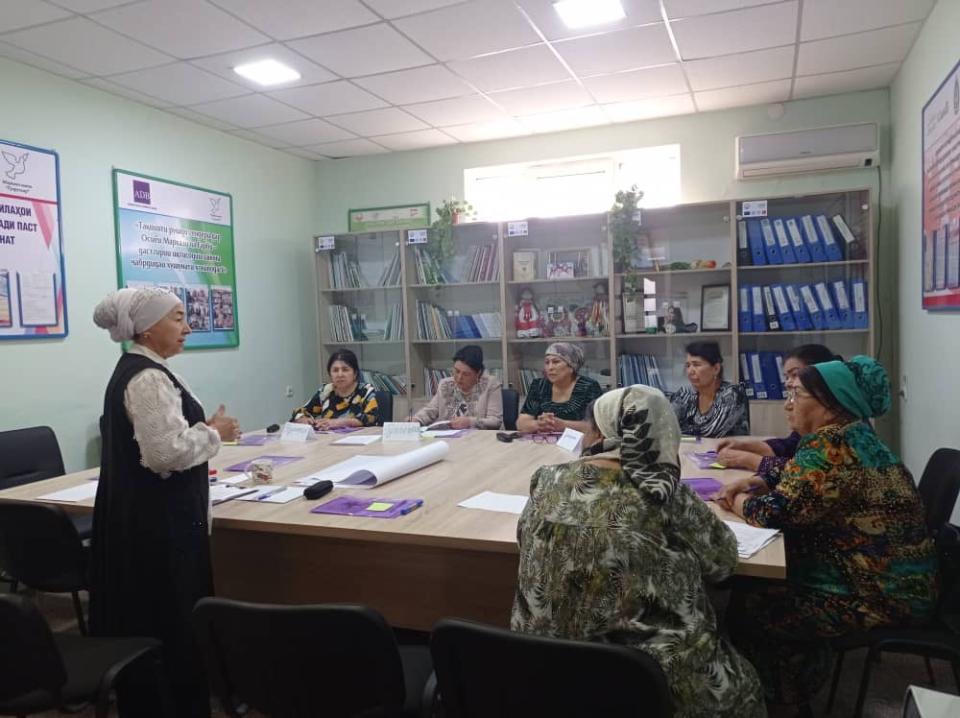
Photo taken during focus group discussion conducted by Gulrukhsor Crisis Center and Shelter
Abstract
Technology-facilitated gender-based violence (TFGBV) presents a significant threat to women, exacerbating gender inequalities and discrimination in digital environments. This paper examines the impact of TFGBV on women in Tajikistan, analysing its social and psychological consequences and discussing the methodological complexities associated with researching this phenomenon. Special attention is given to the application of the feminist methodology to ensure an ethical and inclusive research approach. The study integrates qualitative fieldwork data, emphasising participant narratives and researcher reflexivity.
1. Introduction
As digital technologies evolve, gender-based violence takes new, often less visible yet equally destructive forms. TFGBV encompasses cyberstalking, online discrimination, non-consensual dissemination of personal information, threats, and digital harassment. In societies with entrenched patriarchal traditions, such as Tajikistan, women experience dual pressures − both online and offline.
Women who experience TFGBV often fear exposure and judgment. As one interviewee expressed, “Even if you anonymise everything, someone might still recognise your story. I don’t feel safe” (G. A., 47 years old, journalist). This fear of identification results in self-censorship and withdrawal from online platforms, further limiting women's participation in digital spaces.
This paper addresses the following key research questions:
- What are the primary manifestations of TFGBV in Tajikistan?
- What are the social and psychological repercussions of digital violence?
- What challenges exist in studying TFGBV, and how can they be mitigated?
- How does the feminist approach enhance research ethics and inclusivity in this field?
The study is based on qualitative data collected through in-depth interviews and focus groups with women who have experienced TFGBV.
“Even if you anonymise everything, someone might still recognise your story. I don’t feel safe.”
- (G. A., 47 years old, journalist)
2. Methodology and the feminist research approach
Our feminist internet research approach is rooted in feminist principles, emphasising the autonomy, safety and well-being of women. Our research applied the following strategies:
2.1. Ethical principles and trust
- Ensuring informed consent, including the right to withdraw at any stage.
- Adopting flexible data collection methods to provide a comfortable environment for interviewees.
- Guaranteeing maximum anonymity and data protection for participants.
One participant voiced her scepticism about research confidentiality: “I trust you personally, but I don’t trust the system. How do I know my story won’t be traced back to me?” (I. N., 36 years old, teacher). These concerns highlight the need for rigorous data protection measures to ensure interviewees’ security.
2.2. Inclusivity and women’s participation
- Engaging women from diverse age groups, socioeconomic backgrounds and levels of digital literacy.
- Utilising varied interview formats (one-on-one interviews, focus groups, online surveys).
- Creating a safe space where women not only answer questions but also share their insights on combating TFGBV.
2.3. Researcher reflexivity
- Conducting collective discussions on ethical dilemmas and the influence of researchers’ personal experiences on data interpretation.
- Continuously refining methodologies to minimise re-traumatisation of interviewees.
3. Key forms of TFGBV in Tajikistan
Based on the collected data, the main forms of TFGBV identified include:
1. Cyberbullying and public shaming – Women, especially those active on social media, are subjected to mass online attacks, humiliation and harassment. One interviewee explained, “I lost my job because of online harassment. My employer said the scandal was bad for business.”
2. Family-controlled digital abuse – Monitoring, surveillance and restrictions on internet access imposed by family members as a means of control. A married woman described her experience: “My husband controls my social media. If he sees a comment from a man, he punishes me.”
3. Non-consensual dissemination of personal information – Cases where personal photos or private messages are used for blackmail and coercion.
4. Digital exploitation – Coercion into online interactions or activities involving sexually explicit content.
It would be wrong to say that TFGBV has affected the life of every woman in Tajikistan. There are women who actively reduce their online presence, who self-censor so as not to attract either public attention or provoke a reaction from their husbands who might not approve of their posts or those commenting on them. But most people have seen TFGBV. They have seen the public pile-on where women with a public profile have been targeted with online shaming. They have seen incidents where a personal argument with a teacher, doctor or business owner turns public, spreading slander and insults.
Our research in Tajikistan showed that in some cases women had lost everything as a result of TFGBV; their families, their homes, their jobs. They were afraid to leave the house, afraid for their lives, and were unable to form relationships as a result.
4. Social and psychological consequences of TFGBV
4.1. Psychological trauma
TFGBV results in:
- Chronic stress and anxiety disorders.
- Social withdrawal and fear of offline interactions.
- Loss of self-confidence and feelings of helplessness.
Victims often feel powerless in the face of escalating online violence. One interviewee described her experience: “The harassment kept growing, and I felt like I couldn’t do anything to stop it. I just stopped using the internet altogether” (A. M., 26 years old, housewife).
Our research in Tajikistan showed that in some cases women had lost everything as a result of TFGBV; their families, their homes, their jobs. They were afraid to leave the house, afraid for their lives, and were unable to form relationships as a result. So when undertaking this research, our research team was asking women to unpack this trauma, so that we could also understand.
4.2. Social consequences
TFGBV contributes to women’s marginalisation:
- Job loss due to reputational risks.
- Exclusion from families and communities.
- Self-censorship and withdrawal from digital spaces.
5. Methodological challenges in studying TFGBV
5.1. Reluctance to share experiences
- Fear of repercussions and distrust of the research process.
- Hesitation to participate in interviews or requests to remove personal accounts from the study.
One interviewee stated, “I don’t want my story to be written down. I can tell you, but I don’t want my words to exist somewhere permanently” (O.R., 38 years old, businesswoman). As our study progressed, 1 in 4 cyberbullying victims in our sample refused to talk about their experiences. And even among those who agreed to be interviewed, several subsequently withdrew their consent and asked that their stories not be used in the research report (which we, of course, complied with). This meant that the research took longer than anticipated to complete, as we searched for other women who were willing to be involved.
The research team had a strong focus on confidentiality, anonymity and protecting the identity of women. The women contributing their experiences wanted to know: what are you going to do with the information that I tell you, where are you going to write it down, who are you going to tell, will you use my story? It’s very difficult to answer these questions clearly and honestly. Will the particular story of one woman highlight an overall trend that needs explaining? Because we are right at the start of understanding this issue in Tajikistan, we have to be honest and say, I don’t know. Will someone recognise the story? Even if we anonymise the story there is still a chance that someone might identify with the experience and rightly or wrongly attribute the experience to someone they know.
1 in 4 cyberbullying victims in our sample refused to talk about their experiences. And even among those who agreed to be interviewed, several subsequently withdrew their consent and asked that their stories not be used in the research report
5.2. Influence of patriarchal norms
- Victim-blaming narratives and denial of the problem.
- Lack of recognition of digital risks, shifting responsibility onto women.
A number of women noted, “If a woman behaves properly, she won’t face such problems online.” This widespread belief further silences victims and hinders efforts to combat TFGBV. This social pressure on cyberbullying victims and the denial of the significance of their experiences leads many women who have had such experiences to avoid mentioning them and even to push them out of their consciousness as something inappropriate or simply unimportant. This leads to some potential interviewees refusing to talk to researchers or denying that they have been victims of TFGBV.
We see in Tajikistan that women, particularly but not exclusively older women, are staunch defenders of the patriarchal system. Sometimes these women hold views on gender norms that are more extreme than men. As with offline violence, these women hold other women accountable for bringing violence upon themselves, as a result of non-conformity with gender norms and social etiquette.
Research fieldwork also highlighted other issues around reflexivity, where our own experiences and exposure shape our views. Tech-savvy young women who courted controversy by promoting non-traditional views were hardened to the hate. They couldn’t understand women who allowed themselves to be affected by it. Experts who worked with students on online safety said that TFGBV didn’t happen to young girls as they don’t have phones, contradicting the first-hand evidence of girls who had experienced both offline and online gender violence. These women were ready to say that because it hadn’t happened to them, or didn’t affect them, that it wasn’t important. Research participants could therefore give misleading information, because they themselves haven’t experienced something.
We see in Tajikistan that women, particularly but not exclusively older women, are staunch defenders of the patriarchal system.
As feminist researchers, we have to be very aware of the position we hold while doing the research as part of the society; we have to reflect on the power dynamics between the women participants who are providing knowledge and information about their lived experience at large and us. But we also have to remember how these same factors have influenced the women who are giving us information on the situation at large, and it is important to critically analyse this data to separate their personal experiences from their views about what others should or shouldn’t feel, as these views may not actually correspond with the real lived experiences of other women.
5.3. Emotional toll on researchers
- Compassion fatigue from exposure to traumatic narratives.
- Feelings of helplessness when facing systemic issues.
- Ethical dilemmas regarding the publication of sensitive stories.
The research team was committed to hearing from women in all their diversity, to understanding how the problem of TFGBV alters in different groups and different situations, and to making sure that all women have a voice. The research process showed that feelings of isolation and powerlessness were common in women experiencing TFGBV. The violence is snowballing online and you are sitting staring at your phone feeling powerless to stop it. The research team explored diversity in age, urban versus rural settings, types of profession, level of online presence, disability, and ethnicity. Did the offline vulnerabilities apply to online violence? Or is the internet a leveller that can affect us all? To be heard, we have to find our voice, but someone needs to be there to listen. When research involves discussion of violence and hardship, the research team needs to be ready to listen. We provide an opportunity for someone to speak out, and some people want to share every violent and difficult moment of their life, even if it isn’t relevant to TFGBV. Some of these stories were extremely distressing. It was important that the listening from the research team validated the experiences that the women were sharing.
The interviews and focus groups were conducted by a team of women who had many years of experience working with women who have experienced gender-based violence. Before the field research started, the team spent many hours together discussing the types of TFGBV, how it might impact, who it might impact, different personal experiences of online safety, reflexivity, gender norms and stereotypes in Tajikistan, working methods, ethics, and safety. Even so, conducting the field research had a greater impact on the researchers’ own mental and physical health than they expected. To conduct this type of research you need a very experienced team, people who really understand the local context, who can sensitively approach the subject matter, who put the needs of the women participating as their priority, who can professionally manage themselves, and who have listened to many cases of trauma. It is important not to overload these field researchers. While it might be difficult to find the correct calibre of researcher, and this might impact the number of researchers who can be involved, it is important to avoid potential burnout among the researchers.
The research team tried to cope with these challenges by providing each other with emotional support, spending free time together, and reading inspiring texts about the experiences of other feminist researchers and activists.
To be heard, we have to find our voice, but someone needs to be there to listen. When research involves discussion of violence and hardship, the research team needs to be ready to listen.
6. Recommendations and solutions
6.1. Strengthening legal mechanisms
- Developing legal frameworks to protect women from digital violence.
- Criminalising cyberstalking, harassment and non-consensual data dissemination.
6.2. Enhancing digital literacy
- Implementing educational programmes on digital safety.
- Creating accessible information resources for women.
6.3. Establishing safe online spaces
- Developing support platforms for survivors of TFGBV.
- Facilitating peer networks and psychological assistance.
6.4. Psychological support
- Providing crisis intervention and long-term therapy for affected women.
- Offering emotional support for researchers handling traumatic narratives.
As researchers in TFGBV, we ask women to share some of the most traumatic moments of their lives with us, so that we can understand, so that our research can help protect others in the future. The long-term effects of TFGBV on both the mental and physical health of the women sharing their experiences were visible. Women were offered psychological counselling by trained professionals after sharing their experiences, which many used. But others who relived and retold their experiences didn’t want outside help, even though they reported physical and mental health issues. These issues were particularly evident in the one-to-one interviews. The specific social context needs to be fully considered to properly ensure that the safety and well-being of women are being ensured. Just writing that you have trained counsellors available to those who want them is not enough. If women don’t know them, they don’t want to use them, but still relive the trauma as a result of retelling their experience.
7. Conclusion
TFGBV is a critical issue that exacerbates gender inequality in Tajikistan. This study highlights the deep psychological and social impacts of digital violence while underscoring the methodological complexities of studying such a sensitive topic. The application of the feminist approach enhances research ethics, inclusivity and interviewee safety. Addressing TFGBV requires a holistic approach incorporating legal reforms, digital literacy programmes and robust psychological support systems.
The research taught us a lot as feminist scholars and activists. Here are the key learnings that we would like to share.
Be prepared. Make sure you really have thought about how and what you are going to do before you start. Think about your own safety and the safety of others. Think about your own position, bias, previous knowledge, and what you don’t know.
We have to accept that in the field of violence, many women don’t want to share.
Be prepared to change. As you go into the field research stage, be ready to change all of these assumptions. Really listen to what women are telling you. Make sure you understand them, where they are coming from, what they are trying to tell you.
Be respectful of trauma. Women who share their personal stories have relived the worst moments of their lives so that you can be informed. They may or may not want support from you after that. Respect the trust that they put in you, the boundaries that they set for how their personal information can be used. Make sure that you are deserving of that trust.
Be ready to accept that some people don’t want to share. We want to make sure that our research is actually correct. First-person accounts are the best way of understanding this, as we are not dealing with bias in terms of what others think does or doesn’t happen to others. But we have to accept that in the field of violence, many women don’t want to share.
Be specific. If possible, be specific about what you are going to do with the information that women share. When working in groundbreaking areas, this can be quite difficult to do, but think about what concrete information you can provide.
Be inclusive. Do the women who told their stories want to be part of the research going forward? Not everyone wants to be reminded. Look at how you can continue to include those who provided the information for the research, the language needs, and the presentation requirements, to allow ownership from those who contributed.
Footnotes
1. Gurumurthy, A., & Chami, N. (2020). Feminist Practices in Digital Research. IT for Change.
2. Henry, N., & Powell, A. (2018). Technology-Facilitated Sexual Violence: A Literature Review of Empirical Research. Trauma, Violence, & Abuse, 19(2), 195-208.
3. Herman, J. L. (1992). Trauma and Recovery: The Aftermath of Violence – From Domestic Abuse to Political Terror. Basic Books.
4. UN Women. (2021). Online Gender-Based Violence: A Global Review.
- 176 views





Add new comment